
Dry eye · symptoms
Dry eye symptoms: what they feel like, and when to worry
Dry eye rarely feels “dry”. Most people tell us their eyes feel gritty, tired or sore, or that they water for no reason. Here is every symptom, what it usually means, and the few signs that need help today.
By Sohail Khan, Optometrist and Director, who has dry eye himself · Checked by Abra Arshad, Optometrist and Clinical Director · Updated 12 October 2026 · 11 min read
The most common dry eye symptoms are gritty or sandy eyes, tired eyes by the afternoon, burning, redness, and eyes that water. Vision often blurs and then clears when you blink. Symptoms are usually in both eyes and get worse with screens, heating, wind and long days. If three or more sound like you, it is very likely dry eye.
On this page
What dry eye actually feels like
When patients sit down in my chair, very few say “my eyes are dry”. They use their own words. These are the ones I hear most, and what is going on behind each one.
- Like there’s sand in my eyesGritty or scratchy. The surface of the eye is drying between blinks, so the lid rubs on it.
- My eyes are tired by three o’clockHeavy, achy eyes that get worse through the day. Classic dry eye, especially with screens.
- They burn or stingOften worse in the morning or at night. Common when the oil glands in the lids are blocked.
- They water all the timeIt sounds backwards, but watering is one of the most common dry eye symptoms (more on this below).
- Things go blurry, then clear when I blinkThe tear film is the first lens your eye looks through. When it breaks up, vision smears.
- My eyes look redRed whites of the eyes, or red, puffy lid edges.
- Crusty lashes when I wake upPoints to the lids: blepharitis, or tiny eyelash mites.
- I can’t wear my contact lenses for longLenses that felt fine for years now feel dry by lunchtime.
- Bright light bothers meMild light sensitivity is common in dry eye. Sudden, severe sensitivity is not (see the urgent signs below).
- I keep rubbing themItchy eyes are usually allergy, but itchy lid edges are common with blepharitis and mites.
You don’t need all of these. Most people have three or four, and they come and go. That coming and going is a clue in itself: dry eye changes with your day, the weather and what you are doing.
Why dry eyes water
This confuses almost everyone. Your eyes make two kinds of tears. There are the everyday tears that keep the eye covered, and there are emergency tears, the ones that pour out when you get grit in your eye or peel an onion.
When the everyday tears are poor, usually because the oil layer on top is missing and they dry up in seconds, the eye feels irritated and sends out emergency tears. These are mostly water. They flood the eye, run down your cheek, and do very little to fix the dryness. So you get watery eyes that still feel dry.
If watering is your main problem, read why your eyes water when they are dry.
What each symptom usually points to
Dry eye is not one thing. The pattern of your symptoms tells us a lot before we even look. This is how I think about it in clinic. It is a guide, not a diagnosis.
| If you notice… | It often points to… |
|---|---|
| Gritty, tired eyes, worse later in the day and on screens | Blocked oil glands in the lids (meibomian gland dysfunction, or MGD). This is the most common cause of dry eye. |
| Crusty, flaky lashes in the morning, itchy lid edges | Blepharitis, often with Demodex eyelash mites |
| Eyes worst when you wake up, sore or burning | Lids not closing fully at night, a fan or heating on, or inflamed lids |
| Watery eyes outside, in wind or cold | A poor oil layer, so the eye over-produces watery tears |
| Blurry vision that clears when you blink | An unstable tear film that breaks up too quickly |
| Red lid edges, and redness or flushing on your cheeks and nose | Rosacea, which affects the eyelids too |
| Started after a new tablet or medicine | A side effect. See medicines that cause dry eyes |
| Started after cataract or laser surgery | Very common for a few months. See dry eyes after eye surgery |
| Dry eyes with a dry mouth and aching joints | Possibly Sjögren’s, an immune condition. Mention it to your GP as well as to us. |
Most people have more than one of these at once. That is why one drop rarely sorts it. If you want the full list of reasons, read what causes dry eyes.
I have dry eye too
I have dry eye myself. It is the reason I stopped wearing contact lenses, and the reason laser eye surgery was never an option for me. So when someone tells me their eyes feel like sandpaper by the end of the day, I know exactly what they mean.
The thing I wish someone had told me earlier: the symptoms are not the problem, they are the warning light. Drops calm the warning light. They don’t fix what is causing it.
A quick check you can do now
Ask yourself these six questions about the last two weeks.
- Do your eyes feel gritty, scratchy or sore?
- Do they feel tired or heavy by the afternoon?
- Do they water for no clear reason, especially outdoors?
- Does your vision blur and then clear when you blink?
- Do screens, reading or driving make it worse?
- Do you reach for eye drops more than twice a day?
Three or more “yes” answers and dry eye is likely. For a scored version that tells you how mild or severe it is, take our free 60-second dry eye check. You don’t need to give your details.
Sounds like you?
Every treatment starts with a free consultation with one of our optometrists. We talk through your symptoms, what may be causing them, and if treatment isn’t right for you, we say so before anything starts.
When it isn’t dry eye: get seen today
Don’t wait for a routine appointment if you have:
- A painful red eye, especially just one eye
- Vision that has suddenly dropped and doesn’t clear when you blink
- Strong light sensitivity, where you can’t keep the eye open
- A red, painful eye while wearing contact lenses (take the lens out and don’t put it back)
- Something hit or splashed into the eye
- New flashes of light, a shower of floaters, or a shadow in your vision
Call any of our practices and ask for an urgent appointment, or call NHS 111. If you can’t reach anyone and it is severe, go to A&E. More on red eyes and flashes and floaters.
What makes symptoms worse
Dry eye is often fine first thing and bad by the evening, or fine in summer and bad in winter. These are the usual triggers:
- Screens. You blink about a third as often when you concentrate on a screen, so the tears dry out. See screens and dry eyes.
- Central heating, air conditioning and car fans blowing at your face.
- Wind, cold and flying. Aeroplane cabins are drier than most deserts.
- Poor sleep, alcohol and not drinking enough water.
- Contact lenses, especially later in the day. See why contact lenses dry out.
- Hormones. Many women notice dry eye starting around the menopause. See dry eyes and the menopause.
What happens if you leave it
For some people, mild dry eye stays mild. For many, though, the blocked oil glands slowly get worse. A gland that stays blocked for long enough shrinks, and a gland that has gone does not come back.
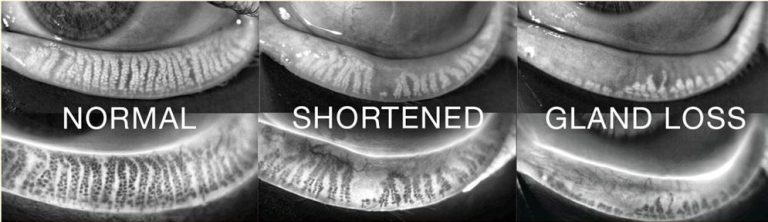
That is the honest reason to get symptoms checked sooner rather than later. It is not an emergency, but the earlier blocked glands are cleared, the more of them you keep.
What actually helps
There are three levels, and most people only ever try the first.
1. Relief: drops, gels and good habits
A preservative-free lubricating drop, a warm compress on the lids, screen breaks, and keeping fans and heating away from your face. These ease symptoms and are worth doing. See which eye drops suit which dry eye.
2. Treating the cause
If drops only help for half an hour, the cause is usually still there: blocked glands, inflamed lids or mites. That is what in-clinic treatment is for, such as clearing the lid edges and lashes, and light therapy (IPL) that calms the inflammation and helps the thick oil flow.
3. Keeping it under control
Dry eye is usually something you manage rather than something that goes away for good. Once it is under control, a simple home routine and a check-up keep it there. See does dry eye go away?
Every treatment and its price is on our dry eye clinic page.
When you don’t need us
If your eyes feel dry now and then, after a long flight, a late night or a big day on the laptop, and they are back to normal by the next morning, you probably don’t need an appointment. A good drop, a screen break and an early night are enough.
Come and see us if symptoms are there most days, if drops only help for a short while, if you’re struggling with contact lenses, or if it is affecting your work, your driving or your sleep.
Questions people ask
Can dry eye cause blurry vision?
Yes. The tear film is the first surface light passes through, so when it breaks up your vision smears. The typical sign is blur that clears when you blink. Blur that does not clear, or a sudden drop in vision, is not typical of dry eye and should be checked the same day.
Can dry eye cause headaches?
It can add to them. Tired, strained eyes after screen work often go with a frontal headache. But headaches have many causes, including an out-of-date glasses prescription, so it is worth having an eye examination too. See headaches from screens.
Can you have dry eye in just one eye?
Usually both eyes are affected, though one often feels worse. If only one eye is red, painful or watering, have it checked, because other problems such as a blocked tear duct or an infection are more likely.
Why are my eyes worse when I wake up?
Common reasons are lids that don’t close fully at night, a fan or heating on in the bedroom, and inflamed lid edges (blepharitis). A gel at bedtime often helps, but it is worth finding the cause.
Is dry eye serious?
Dry eye is very common and rarely damages your sight. But it can make daily life miserable, and blocked oil glands can shrink over time if they are left. Severe dry eye, or dry eye with other symptoms such as a dry mouth and joint pain, should always be looked at.
Do I need a referral to see you?
No. You can book directly at any of our five practices. It is not usually available on the NHS, so we show every price up front.
- Dry eye usually feels gritty, tired, burning or watery, not “dry”
- Blurry vision that clears when you blink is a classic sign
- Watery eyes are often dry eyes, because poor tears trigger emergency tears
- A painful red eye, sudden blur or a contact lens eye that hurts needs help today
- Drops ease the symptoms. Treating the cause is what stops them coming back
Ready to find out what is causing yours?
Most people start with EyeRelief, and it starts with a free consultation, at any of our five practices: Cheadle, Heald Green, Middleton, Winsford and Heckmondwike. No referral needed.
- Craig JP et al. TFOS DEWS II Definition and Classification Report. The Ocular Surface, 2017.
- Lemp MA et al. Distribution of aqueous-deficient and evaporative dry eye in a clinic-based patient cohort. Cornea, 2012.
- NICE Clinical Knowledge Summaries: Dry eye disease.
- Tsubota K, Nakamori K. Dry eyes and video display terminals. New England Journal of Medicine, 1993.