
Dry eye · screens
Screens and dry eyes: why a day on a screen dries your eyes, and what helps
Screens don’t damage your eyes. But when you concentrate on one, you blink less often and less fully, and your tears dry out. Here is how that works, what to change at your desk, and when it is more than the screen.
By Sohail Khan, Optometrist and Director, who has dry eye himself · Checked by Abra Arshad, Optometrist and Clinical Director · Updated 12 October 2026 · 11 min read
Yes, screens can dry your eyes, mainly because of how you blink while you use them. When you concentrate, you blink about a third as often, and more of your blinks don’t fully close. Each full blink spreads fresh tears and oil over the eye, so fewer full blinks means the surface dries between them. Lower the screen, take real breaks, blink fully, keep air off your face and get glasses that suit the screen distance. If your eyes still feel gritty or burn most days, the cause is usually more than the screen.
On this page
- How blinking keeps your eyes comfortable
- Do screens cause dry eyes?
- Why fewer blinks dry the surface
- What screen dryness usually feels like
- Screen height and desk setup
- Office air, heating, air conditioning and fans
- I know the mid-afternoon grit
- The 20-20-20 rule and blinking exercises
- Do blue light filters help dry eyes?
- The right glasses for screen distance
- Children, phones and dry eyes
- When screens aren’t the whole story
- When you don’t need us, and when you do
- Questions people ask
How blinking keeps your eyes comfortable
The front of your eye is covered by a thin layer of tears, the tear film. It has three parts: mucus next to the eye, which helps the tears stick; water in the middle, which keeps the surface wet; and a very thin layer of oil on top, which slows evaporation.
The oil comes from rows of tiny glands in your eyelids, called meibomian glands. Every blink squeezes a little oil out and spreads it, with fresh tears, across the eye. Blink rarely, or only halfway, and the surface starts to dry before the next blink.
Do screens cause dry eyes?
Screens don’t harm the eye itself. What they change is the way you blink.
In the study most often quoted, office workers blinked around 22 times a minute when relaxed, 10 when reading a book and about 7 on a screen: about a third as often. Other studies found different numbers, but the direction is always the same.
An honest twist: when a screen and a printed page were matched for text size and contrast, blink rate was about the same for both. The main reason you blink less is concentration, not the screen.
What the screen does seem to change is that more of your blinks are incomplete: the top lid doesn’t meet the bottom one. Studies found more half-blinks on computers, tablets and phones than on paper, rising over an hour of smartphone reading.
Why fewer blinks dry the surface
The longer the gap between blinks, the more the tears evaporate, and dry patches feel gritty, burning or tired. Half-blinks leave the bottom of the eye exposed, and they squeeze less oil out of the glands, so the tears evaporate faster still.
Many specialists think oil that isn’t squeezed out regularly may thicken and help block the glands over time. That is likely but not proven. Dryness can also make your eyes water, as the eye sends out emergency tears: see why dry eyes water.
What screen dryness usually feels like
- Fine in the morning, shot by mid-afternoonSymptoms that build through the working day are typical of screen dryness.
- The screen blurs, then clears when I blinkThe tear film is breaking up between blinks.
- Gritty, like I need to rub themDry patches on the surface. More on gritty, burning eyes.
- Better at weekendsA good clue that the screen and the office are a big part of it.
Screen height and desk setup
When you look straight ahead or up, your eyelids open wider and more of the eye is exposed to the air. When you look slightly down, the top lid covers more of the eye, so less of it can dry. That is why the usual advice is to put the top of the screen at or just below eye level. There is no proven ideal angle.
| Change | Why it helps |
|---|---|
| Top of the screen at or just below eye level | You look slightly down, so less of the eye is exposed. |
| Screen about an arm’s length away, text large | Small or faint text makes you stare harder and blink less. |
| No bright window behind or beside the screen | Glare makes you squint and can cut your blink rate. |
| Laptop on a stand, separate keyboard | Lets you set the height instead of hunching. |
If you tip your head back to see the screen through varifocals, your eyes open wider and your neck aches. A lens made for the desk often fixes both (see below).
Office air, heating, air conditioning and fans
How fast your tears evaporate also depends on the air. Heating and air conditioning both dry it, and low office humidity is linked with more dryness. Point desk fans and car vents away from your face. If one hot-desk is always worse, look for an air outlet above it.
Humidifiers? Small studies found a desktop humidifier improved comfort over a short time, though in one a cool-mist device did no better than a dummy. Worth a try, but not a fix on its own.
Drops. A preservative-free lubricating drop at your desk can ease a long afternoon. Needing one every hour or two means it is covering a problem. See the best eye drops for dry eyes.
Still gritty after you’ve fixed your desk?
Every treatment starts with a free consultation with one of our optometrists. We talk through what may be causing it, and if treatment isn’t right for you, we say so.
I know the mid-afternoon grit
I have dry eye myself. It is why I stopped wearing contact lenses, and why laser eye surgery was never an option for me. So when someone tells me their eyes feel like sandpaper by three o’clock, I know what they mean.
The screen is rarely the whole story. It turns a borderline tear film into a sore one. Fix the habits and the setup first, and if your eyes are still bad, look for the cause underneath.
The 20-20-20 rule and blinking exercises
Every 20 minutes, look at something 20 feet (about 6 metres) away for 20 seconds. The evidence is thinner than most websites suggest. In one small study of 29 people, reminders to follow the rule improved eye strain and dry eye symptoms over two weeks, but the benefit was gone a week after the reminders stopped. It helps while you do it.
Use that reminder to blink properly too. In one trial, people with dry eye did a 10-second blinking exercise every 20 minutes for four weeks. Their symptoms improved and their share of half-blinks fell from about half to about a third. A simple version:
- Close your eyes gently until the lids touch.
- Pause for two seconds.
- Squeeze gently for two seconds, then open. Repeat a few times.
Do blue light filters help dry eyes?
No, the evidence doesn’t show that they do. Blue light is not what dries your eyes. Blinking is.
In 2023 a Cochrane review, which pulls together the best available trials, found blue-light filtering glasses may make no difference to eye strain from computer use in the short term. The international TFOS report on screens and the eye agreed that blue-blocking is not an effective way to manage screen eye strain. There is no harm in a blue-filter lens if you like one, but don’t buy it to fix dry or tired eyes.
The right glasses for screen distance
An out-of-date prescription, or one meant for distance or reading but not the screen, makes you squint, lean in and stare, and staring means fewer blinks. You need a full prescription for the distances you actually work at. Reading glasses are set closer than most screens, and varifocals put the screen zone in a narrow strip. A lens set for your desk can make a big difference: see our office and screen lenses.
If headaches are your main problem rather than dryness, read headaches from screens.
Children, phones and dry eyes
Children blink less on screens too. A study of over 900 children in Korea found those with dry eye used smartphones for longer each day and spent less time outdoors. When they stopped using smartphones for four weeks, their symptoms and eye signs improved. It is one study, but a useful nudge: breaks, time outdoors, the phone held further away, and no screens in a dark bedroom.
If a child keeps rubbing their eyes or says they feel sore, bring them in for an eye examination.
When screens aren’t the whole story
If breaks, blinking and a better desk don’t help, the screen is probably exposing a problem that was already there, most often blocked oil glands in the eyelids (MGD). With a thin oil layer, tears evaporate in seconds whatever your desk is like.
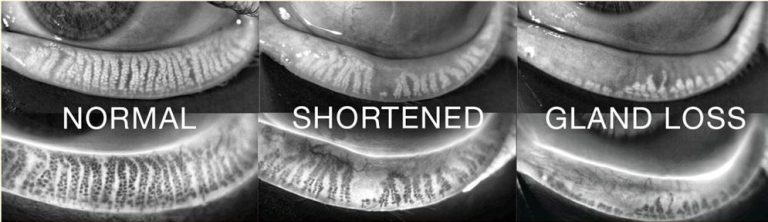
Signs it is more than the screen: sore or gritty eyes most days, including weekends; drops that wear off within an hour; eyes worst when you wake; red or crusty lid edges; or contact lenses that have become hard to wear (see why contact lenses dry out).
For the other reasons, read what causes dry eyes. A daily warm compress is a good start: see our home lid routine. When glands are blocked, in-clinic treatment such as IPL light therapy treats the cause. Not sure? Try our 60-second dry eye check.
When you don’t need us, and when you do
If your eyes feel tired after a long day on a screen but are fine the next morning, you probably don’t need an appointment. Breaks, full blinks, a lower screen and air off your face are usually enough.
Come and see us if it is there most days, if drops only help briefly, or if it affects your work or sleep. Every treatment starts with a free consultation, and every treatment and price is on our dry eye clinic page.
Get seen the same day if you have:
- Eye pain, or one very red, painful eye
- A sudden drop in vision that doesn’t clear when you blink
- Strong light sensitivity, or a painful red eye with contact lenses (take the lens out)
Call any of our practices or NHS 111, or go to A&E if it is severe. More on urgent eye signs.
Questions people ask
Can screens damage your eyes permanently?
There is no good evidence that screens damage the eye. The dryness and strain usually settle with rest. The longer-term worry is blocked oil glands, which can be lost if left untreated, whatever caused them.
Why are my eyes dry after using my phone?
You blink less and more of your blinks are half done while you focus on a phone, often for long stretches. Look up, blink fully and take breaks.
Is it dry eye or eye strain?
They often overlap. Grit, burning and blur that clears with a blink point to dry eye. Headaches and trouble focusing point more to glasses. Many people have both.
- Screens dry your eyes mainly because you blink less, and less fully, while you concentrate
- Put the screen slightly below eye level and keep air off your face
- The 20-20-20 rule helps while you do it, so set a reminder and blink fully
- Blue light filters don’t help dry eyes or eye strain
- Gritty eyes most days, including weekends, usually means more than the screen
Want to know what is behind your screen dryness?
Most people start with EyeRelief, and it starts with a free consultation, at any of our five practices: Cheadle, Heald Green, Middleton, Winsford and Heckmondwike. No referral needed.
- Wolffsohn JS et al. TFOS Lifestyle: Impact of the digital environment on the ocular surface. The Ocular Surface, 2023. Open access
- Singh S et al. Blue-light filtering spectacle lenses for visual performance, sleep, and macular health in adults. Cochrane Database of Systematic Reviews, 2023. Full review
- Talens-Estarelles C et al. The effects of breaks on digital eye strain, dry eye and binocular vision: testing the 20-20-20 rule. Contact Lens and Anterior Eye, 2023. Abstract
- Kim AD et al. Therapeutic benefits of blinking exercises in dry eye disease. Contact Lens and Anterior Eye, 2021. Abstract
- Moon JH et al. Smartphone use is a risk factor for pediatric dry eye disease. BMC Ophthalmology, 2016. Full text
- Patel S et al. Effect of visual display unit use on blink rate and tear stability. Optometry and Vision Science, 1991. Abstract