
Dry eye · mornings
Dry eyes in the morning: why your eyes are sore when you wake up
Most dry eye is worst at the end of the day. If yours is worst first thing, that points somewhere specific: what happens to your eyes while you sleep. Here is how to find your reason, and what helps.
By Sohail Khan, Optometrist and Director, who has dry eye himself · Checked by Abra Arshad, Optometrist and Clinical Director · Updated 12 October 2026 · 11 min read
While you sleep you make fewer tears and stop blinking, so anything that lets air reach the eye overnight leaves it dry by morning. The usual reasons are lids that don’t fully close, a fan, heating or air con on your face, a leaking CPAP mask, and inflamed lid edges (blepharitis), which also cause stuck-together lashes. A thicker night gel or ointment helps most people. A sharp pain in one eye as you open it is different: get it seen.
On this page
- What morning dry eye feels like
- What happens to your tears at night
- Eyelids that don’t fully close at night
- Why I ask about mornings
- Fans, heating, air con and the bedroom window
- CPAP masks
- Crusty lashes and eyes stuck together
- Blocked oil glands
- Alcohol, late screens and what you do before bed
- Floppy eyelids and sleep apnoea
- Sharp pain when you open your eye: recurrent corneal erosion
- What helps morning dry eye
- When you don’t need us, and when you do
- Questions people ask
What morning dry eye feels like
The pattern is the same: eyes at their worst when you wake, easing over the first hour.
- Gritty the moment I open my eyesThe surface dried overnight. Blinking spreads fresh tears and it settles.
- One eye is always worseOften the side you sleep on, or the side facing a fan, window or CPAP leak.
- My lashes are stuck togetherCrusts at the lash roots. Usually blepharitis.
- A sudden sharp pain when I open my eyeDifferent from dryness. It needs to be seen (more below).
Fine in the morning but worse as the day goes on? That pattern is more often screens and blocked oil glands. See dry eye symptoms.
What happens to your tears at night
Your tear film has three layers: mucus next to the eye so tears stick, a watery middle layer, and a thin layer of oil on top, from the meibomian glands in your lids, that stops the water evaporating. By day, every blink adds a little oil and spreads a fresh film.
At night you make fewer tears and you stop blinking. That is normal, because the closed lids seal the eye in a small, humid space. Morning dryness starts when that seal fails, when dry air gets in, or when the lid edges are inflamed.
Eyelids that don’t fully close at night
This surprises most people. It is called nocturnal lagophthalmos: the lids don’t close all the way during sleep, leaving a strip of the eye, usually the lower part, open to the air for hours. Some people simply sleep this way without knowing. It is more likely:
- After eyelid surgery, such as a lid lift or ptosis surgery.
- After Bell’s palsy, which weakens the muscle that closes the eye on one side.
- With thyroid eye disease, where the eyes sit further forward.
- With prominent eyes, or lids that have loosened with age.
New weakness on one side of your face is a same-day problem: call 999 if there are other stroke signs, otherwise your GP or NHS 111.
How to tell
Ask a partner to look at your eyes while you’re asleep. A white line between the lids is the giveaway. Other clues: it is always the same eye, and mornings are better with a sleep mask on. In clinic, a harmless orange dye shows a dry band across the lower part of the cornea (the clear front window), exactly where the gap sits.
Why I ask about mornings
I have dry eye myself. It is why I stopped wearing contact lenses, and why laser eye surgery was never an option for me. When I set up the dry eye clinics at our five practices, I wanted us to ask everyone one question: “When are your eyes at their worst?” Evenings point us to screens and oil glands. Mornings point us to what happens while you sleep.
Worst first thing?
Every treatment starts with a free consultation with one of our optometrists. We check how your lids close, look at your tears and oil glands, and tell you what is causing it. If treatment isn’t right for you, we say so before anything starts.
Fans, heating, air con and the bedroom window
Closed lids are not airtight. A draught across your face all night dries the lids and any small gap between them. The usual culprits: a fan pointed at the bed, heating left on overnight, air conditioning, and sleeping by a window, which explains why it is often one eye. Change one thing for a week and see if mornings improve.
CPAP masks
If you use CPAP and wake with dry eyes, suspect the mask. A small leak at the top blows air over your eyes all night, often worse on one side. Don’t stop your CPAP: a better fit or a different mask usually sorts it. See CPAP and dry eyes.
Crusty lashes and eyes stuck together
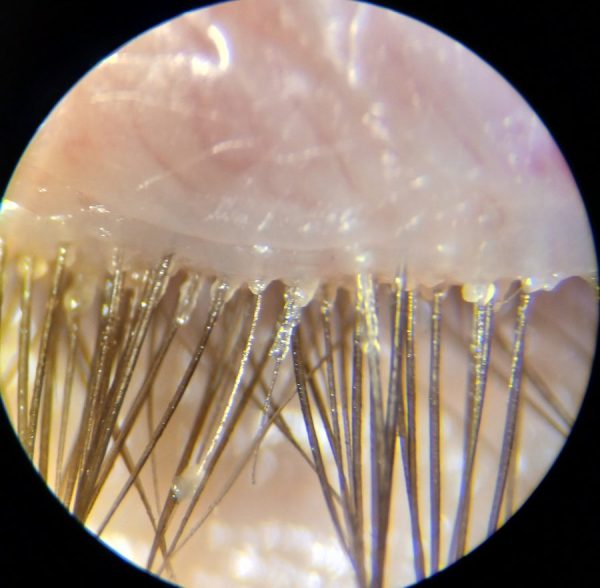
Crusts on your lashes, or lids that feel glued shut, usually mean blepharitis, inflammation along the lash line. By day, blinking washes flakes away. At night they build up and dry into crusts, so blepharitis often feels worst in the morning, with burning, itchy, red lid edges.
A common cause of stubborn blepharitis is eyelash mites (Demodex), which leave a dandruff-like collar around each lash. Many people notice the itch most at night and first thing. A regular lid clean helps: see our home lid routine.
A red eye with sticky yellow or green discharge is more likely conjunctivitis, an infection; a pharmacist can advise. If it is painful, your vision is affected or you wear contact lenses, get it checked the same day. See red eye: when to worry.
Blocked oil glands
When the oil glands in your lids block (meibomian gland dysfunction, or MGD), tears evaporate too fast. MGD usually feels worst later in the day, but it often comes with blepharitis, and a poor oil layer makes any gap in the lids at night harder to cope with. If drops only help for a short while, treating blocked oil glands deals with the cause.
Alcohol, late screens and what you do before bed
- Alcohol is linked with drier eyes, and many people notice it the next morning.
- Screens in bed. You blink less often and less fully, so your eyes start the night dry. See how screens dry your eyes.
- Some night-time medicines, such as certain sleeping tablets and antihistamines, reduce tears. Never stop one without your GP. See medicines that cause dry eyes.
- Sleeping in contact lenses, even for a nap, dries the eye and raises the risk of infection, unless they were fitted for overnight wear. See why contact lenses dry out.
Floppy eyelids and sleep apnoea
In floppy eyelid syndrome the upper lids are very loose and rubbery. At night they can flip out against the pillow, so people wake with red, irritated, sometimes sticky eyes, often worse on the side they sleep on. It is most common in overweight men and is strongly linked with obstructive sleep apnoea, where breathing stops and starts during sleep.
Not everyone with floppy lids has sleep apnoea. But if you also snore loudly, someone has seen you stop breathing, or you are very sleepy by day, speak to your GP. It matters for your general health, not just your eyes.
Sharp pain when you open your eye: recurrent corneal erosion
This one needs to be seen
A sudden, sharp pain in one eye as you open it, often with watering, light sensitivity and blur, may be a recurrent corneal erosion. The surface layer of the cornea is not sticking down properly. Overnight it sticks to the lid, and tears away when you open your eye. It often follows an earlier scratch, from a fingernail, paper or a twig, sometimes months or years before.
Get it checked the same day: call any of our practices for an urgent eye appointment, or NHS 111. Don’t rub it. It is usually managed with lubricants by day and an ointment at night, often for months; your optometrist or eye doctor will advise. Other signs that need help today are in our urgent signs.
What helps morning dry eye
- A thicker gel or ointment at bedtime. The most useful single change. Ask a pharmacist for a preservative-free eye gel or ointment made for night use. It blurs your vision, so put it in once you are in bed, never with contact lenses in. See choosing eye drops.
- Change the bedroom. Fan off or turned away, heating lower overnight, bed away from the window, a humidifier if the air is dry.
- Look after your lids. For crusty, burning lid edges, a regular warm compress and lid clean. It takes a few weeks.
- Sleep masks and moisture goggles. A soft mask stops draughts. Moisture goggles keep humid air over each eye, which suits lids that don’t fully close. Nothing should press on the eyes.
- Taping, only on professional advice. Some people with lids that don’t close are advised to tape them at night. Don’t try it yourself: badly placed tape can scratch the eye.
If the cause is blocked glands, blepharitis or mites, in-clinic treatment clears them. Some causes need a doctor: a GP or eye doctor prescribes any prescription treatment, and some lid problems need an eye specialist. Every treatment we offer, and its price, is on our dry eye clinic page.
When you don’t need us, and when you do
You probably don’t need us if your eyes are a little dry on waking now and then, settle within minutes, and improve once you turn off the fan or add a night gel.
Come and see us if it happens most mornings despite those changes, one eye is always worse, a partner has seen your eyes don’t close, crusty lashes keep coming back, or your eyes are dry in the morning and through the day.
Same day for a sharp pain on waking, a painful red eye, a sudden drop in vision, or a painful eye with contact lenses.
Not sure it is dry eye? Try the 60-second dry eye check, or read what causes dry eyes.
Questions people ask
Why are my eyes dry when I wake up but fine later?
Overnight you make fewer tears and don’t blink, so a gap in the lids, a fan or a CPAP leak dries the surface. Once you are awake and blinking, fresh tears repair it.
Is it normal to sleep with your eyes slightly open?
Some people do without noticing. It only matters if it causes symptoms. If it is new, or started after eyelid surgery, Bell’s palsy or a thyroid problem, have it checked.
Why are my eyes stuck together in the morning?
Usually crusts from blepharitis that build up overnight. A red eye with sticky yellow or green discharge is more likely an infection. A painful eye or blurred vision needs checking the same day.
Do I need a referral to see you?
No. You can book directly at any of our five practices. Dry eye treatment is not usually available on the NHS, so we show every price up front.
- At night you make fewer tears and stop blinking, so the closed lids protect the eye
- Lids that don’t fully close are a common hidden cause: ask a partner to look
- Fans, heating, windows and CPAP leaks dry the eye overnight
- Stuck-together lashes usually mean blepharitis or mites
- A sharp pain in one eye on waking needs to be seen the same day
Want to know why your eyes are worst in the morning?
Most people start with EyeRelief, and it starts with a free consultation, at any of our five practices: Cheadle, Heald Green, Middleton, Winsford and Heckmondwike. No referral needed.
- Craig JP et al. TFOS DEWS II Definition and Classification Report. The Ocular Surface, 2017. Abstract
- Latkany RL, Lock B, Speaker M. Nocturnal lagophthalmos: an overview and classification. The Ocular Surface, 2006. Abstract
- Aiello F et al. Lax eyelid condition and floppy eyelid syndrome prevalence in obstructive sleep apnea syndrome patients: a systematic review and meta-analysis. Graefe’s Archive for Clinical and Experimental Ophthalmology, 2022. Full text
- College of Optometrists. Clinical Management Guidelines: Recurrent corneal epithelial erosion syndrome. Guideline
- NHS. Blepharitis. nhs.uk
- NHS. Dry eyes. nhs.uk