
Dry eye · rosacea
Rosacea and dry eyes: what ocular rosacea is, and what helps
Rosacea is usually thought of as a skin condition. But the same inflammation that reddens the cheeks often reaches the eyelids, causing burning eyes that keep coming back.
By Sohail Khan, Optometrist and Director, who has dry eye himself · Checked by Abra Arshad, Optometrist and Clinical Director · Updated 12 October 2026 · 11 min read
Ocular rosacea is rosacea affecting the eyes and eyelids. It affects more than half of people with skin rosacea, and in some people the eyes are affected before the skin shows much at all. Inflamed lid edges block the oil glands, so the tears dry out fast. Typical signs are burning, gritty, red eyes, red lid edges and styes that keep coming back. It can’t be switched off, but daily lid care, help from your GP when needed and in-clinic treatment for the glands usually keep it well controlled.
On this page
- What rosacea is
- How often rosacea affects the eyes
- Why rosacea makes your eyes dry
- Rosacea eye symptoms
- The rare serious form: when rosacea reaches the cornea
- Triggers: heat, alcohol, spicy food and sun
- What you can do at home
- Why I look at the lids first
- What your GP or dermatologist may prescribe
- IPL: first used for rosacea skin, now for dry eye
- When you don’t need us, and when you do
- Questions people ask
What rosacea is
Rosacea is a long-term inflammatory condition of the facial skin. It shows as easy flushing, redness across the cheeks and nose that stays, small visible blood vessels, and spots that look a bit like acne. It usually starts between 30 and 50, is more common in women, and is more often missed in darker skin, where redness is harder to see.
The exact cause is unknown: probably an over-reactive immune system in the skin, blood vessels that widen too easily, and a reaction to tiny mites on the skin. It is not an infection and not contagious. Menopause flushes are different, though dry eyes in the menopause are common too.
How often rosacea affects the eyes
UK GP guidance (NICE Clinical Knowledge Summaries) puts it at more than half, and up to three-quarters, of people with rosacea on the skin.
- The eyes don’t follow the skinMild skin rosacea can come with troublesome eyes, and the other way round.
- The eyes can come firstSome people have eye signs before the skin signs are obvious, and are treated for “dry eyes” for years first.
- There is no single testIt is diagnosed by looking at the lids, glands, tears and skin together, so it is often missed.
Why rosacea makes your eyes dry
Your tear film has three layers: mucus that helps tears stick to the eye, water in the middle, and a thin layer of oil on top that stops the water evaporating. The oil comes from a row of tiny meibomian glands in each eyelid, which open just behind the lashes. Rosacea upsets this in four ways.
- The oil glands block. The oil turns thick, more like butter than olive oil, and plugs the openings. With less oil, the tears evaporate in seconds. This is meibomian gland dysfunction (MGD), the main way rosacea causes dry eye.
- The lid edges inflame. The lid margin is skin too, and goes red, rounded and thickened. This is a form of blepharitis, and it makes the glands block faster.
- Small blood vessels grow along the lids. Like those on the cheeks, they are thought to keep feeding inflammation into the glands, which is why cleared glands tend to block again.
- Demodex mites. Most adults have these tiny mites in their lash roots, but people with rosacea tend to have many more, which adds to the inflammation. Read about Demodex eyelash mites.
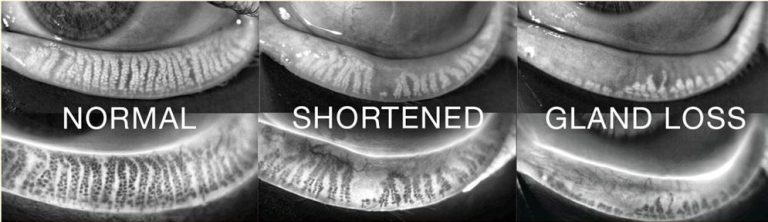
A gland that stays blocked long enough can shrink, and a lost gland does not come back. That is the main reason not to put up with ocular rosacea for years.
Rosacea eye symptoms
These overlap with ordinary dry eye symptoms; the clue is having them with facial redness and involved lid edges.
- Burning, stinging or grittinessOften worse in the morning. See gritty, burning eyes.
- Red lid edges and red eyesOften flaring with the same things that make your face flush.
- Styes and chalazia that keep coming backBlocked glands swell into tender lumps. Repeat lumps are a strong clue. See styes and chalazia.
- Mild light sensitivityCommon with a dry surface. Strong light sensitivity is different (see below).
- Watery eyes, and blur that clears when you blinkThe tear film breaks up, and the eye floods itself with watery tears that don’t help.
- Crusty or flaky lashesOften with Demodex, especially if the lid edges itch.
Not sure if it is mainly the lids or the tears? See blepharitis or dry eye. In rosacea it is usually both.
The rare serious form: when rosacea reaches the cornea
In a small number of people, the inflammation spreads to the cornea, the clear front window of the eye. This is rosacea keratitis. It can cause new blood vessels to grow into the cornea, thinning, scarring and ulcers, and can permanently reduce vision. It needs an eye doctor (ophthalmologist), quickly.
Get seen today if you have rosacea and:
- Real eye pain, not just grittiness or burning
- Strong light sensitivity, where you struggle to keep the eye open
- Vision that has dropped and doesn’t clear when you blink
- One eye much redder and more painful than the other
- A painful red eye while wearing contact lenses (take the lens out)
Call any of our practices for an urgent appointment, or call NHS 111. If you can’t reach anyone and it is severe, go to A&E. More on when a red eye is a worry.
Rosacea and sore eyes?
Every treatment starts with a free consultation with one of our optometrists. We talk through your eyes and skin, what may be going on, and if treatment isn’t right for you, we say so before anything starts.
Triggers: heat, alcohol, spicy food and sun
The NHS lists the common triggers as alcohol, spicy food, hot drinks, sunlight, hot or cold weather, hard exercise and stress. Many people find their eyes flare with the same things as their face.
Honestly, the evidence comes mostly from what people report, not trials, and triggers differ a lot between people. Rather than cutting out everything, UK GP guidance suggests a diary for a few weeks, then avoiding what really is a pattern for you. A few things help most eyes:
- Sun: wraparound UV-protective sunglasses (UK guidance mentions these for ocular rosacea) and high-factor sunscreen.
- Eyeliner: keep it off the inner rim of the lid, where the glands open.
- Medicines: some reduce tears. Don’t stop anything, but ask. See medicines that can dry your eyes.
What you can do at home
Daily lid care is the base of all ocular rosacea treatment, and it is what UK GPs are advised to start with. Do it every day, and keep going when your eyes feel better.
- Warm compress. A heated eye mask or microwavable eye bag on closed lids for about ten minutes softens the thick oil. If heat flares your skin, keep it gentle.
- Lid massage. Straight after, roll gently along the lids towards the lashes to ease the oil out.
- Clean the lid edges. A lid wipe or eyelid cleanser along the lash line twice a day. Tea tree products are often used when Demodex is involved. Our home lid routine goes step by step.
- Lubricating drops. Preservative-free, and with blocked glands, drops containing lipids often suit best. See which eye drops to choose.
If a few weeks of this hasn’t helped, it is time for a closer look.
Why I look at the lids first
I have dry eye myself. It is why I stopped wearing contact lenses, and why laser eye surgery was never an option for me. When I set up the dry eye clinics at our five practices, I wanted every patient’s lids and oil glands looked at properly, not just their tears. With rosacea, that is usually where the problem sits.
What your GP or dermatologist may prescribe
Prescriptions are for your GP, dermatologist or eye doctor to decide. We can’t prescribe these, but we can write to your GP with what we find. This is what is commonly used in the UK.
| Treatment | What it is for |
|---|---|
| Skin creams and gels: ivermectin, metronidazole, azelaic acid; brimonidine gel for redness | Rosacea on the face. Not for use in or on the eye. |
| An oral antibiotic, often low-dose doxycycline | Moderate to severe skin rosacea, and often used by doctors for ocular rosacea and stubborn blocked glands. At low doses it mainly calms inflammation, over several weeks. It is not used in pregnancy or breastfeeding, and alternatives such as erythromycin or azithromycin exist. |
| Anti-inflammatory eye drops | Used by eye doctors for flare-ups or when the cornea is involved, as a short, supervised course. |
Doxycycline makes skin burn more easily in the sun. If eye symptoms carry on despite good lid care, GP guidance is to refer you to an ophthalmologist. Whatever you are prescribed, keep the lid routine going.
IPL: first used for rosacea skin, now for dry eye
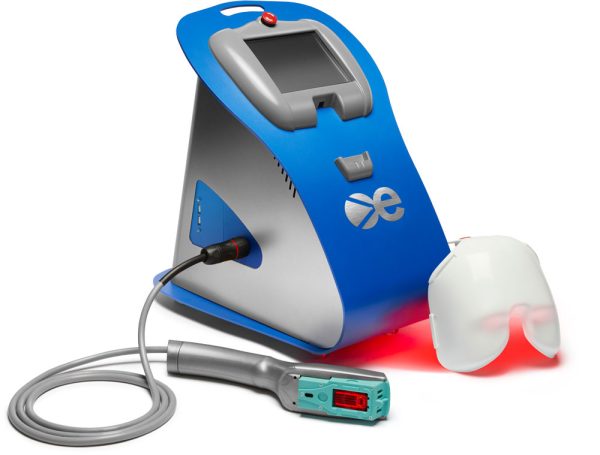
Intense pulsed light (IPL) was developed for the skin. Dermatologists have used it since the 1990s for redness and visible vessels, including in rosacea, and UK GP guidance still lists it as a specialist option for rosacea redness.
Its use for dry eye came from people having IPL for facial rosacea saying their dry eyes felt better too. In 2015 a US eye doctor, Rolando Toyos, reported 91 patients with blocked oil glands treated with IPL and gland expression, most of whom improved. With no comparison group, that showed promise, not proof.
Applied below the shielded eyes, it is thought to close inflamed lid vessels, soften the oil, calm inflammation and reduce Demodex, which is why it fits rosacea in theory.
What the evidence says, honestly
- A Cochrane review in 2020 found too few good trials to say for sure whether IPL helps.
- Newer randomised trials mostly show better symptoms and tears over several months, but many are small and short.
- The international TFOS DEWS II report includes IPL as an option for dry eye from blocked oil glands.
- It needs a course of sessions, and doesn’t suit every skin type or every medicine. We check first.
Read more on IPL for dry eye and other treatment for blocked oil glands. Most people with rosacea need more than one.
When you don’t need us, and when you do
If your rosacea is well controlled, your eyes are comfortable and you don’t get styes, you don’t need an appointment for it. Just mention it at your next eye examination.
Come and see us if your eyes burn, feel gritty or look red most days, you keep getting styes, drops only help briefly, or lid care hasn’t helped after a few weeks. Not sure? Take our 60-second dry eye check, or read does dry eye go away? Every treatment and price is on our dry eye clinic page.
Questions people ask
Can you have ocular rosacea without skin rosacea?
Yes. Some people have eye signs with very mild skin changes, and the eyes can be affected before the skin signs are obvious.
Is ocular rosacea serious?
For most people it is uncomfortable rather than dangerous. In a small number it affects the cornea, which can threaten vision. Pain, strong light sensitivity or vision that drops needs to be seen the same day.
Does ocular rosacea go away?
Rosacea is long-term and comes and goes. With daily lid care and the right treatment, most people get it well controlled, with fewer, milder flares.
Do I need a referral to see you?
No. You can book directly at any of our five practices. In-clinic dry eye treatment is not usually available on the NHS, so we show every price up front.
- More than half of people with rosacea have it in their eyes too
- The eyes can be affected first, and mild skin doesn’t mean mild eyes
- Rosacea blocks the eyelid oil glands and inflames the lid edges
- Daily warmth, massage and lid cleaning is the base of all treatment
- Pain, strong light sensitivity or dropping vision needs help today
Want to know what rosacea is doing to your lids?
Most people start with EyeRelief, and it starts with a free consultation, at any of our five practices: Cheadle, Heald Green, Middleton, Winsford and Heckmondwike. No referral needed.
- NICE Clinical Knowledge Summaries. Rosacea: prevalence and management (revised October 2025).
- NHS. Rosacea.
- Vieira AC, Mannis MJ. Ocular rosacea: common and commonly missed. J Am Acad Dermatol, 2013.
- Toyos R et al. Intense pulsed light treatment for dry eye disease due to meibomian gland dysfunction. Photomed Laser Surg, 2015.
- Cote S et al. IPL therapy for meibomian gland dysfunction. Cochrane Review, 2020.
- Jones L et al. TFOS DEWS II Management and Therapy Report. The Ocular Surface, 2017.