
Dry eye clinic · Manchester, five practices
Dry eye clinic in Manchester
Five practices, one way of treating dry eye: find the cause, show it to you, and treat that. For most people the cause is oil glands in the eyelids that have blocked, which is why years of drops changed nothing. Treatment is available within the week, and the same day as your assessment where we can.

Does this sound like your eyes?
Three or more of these, and it is almost certainly your glands. Which means it can be treated.
- “By mid-afternoon my eyes feel as though there is grit in them.”
- “They stream in the wind, in the car, walking into the supermarket.”
- “The screen smears, then clears for a second when I blink.”
- “Drops buy me ten minutes.”
- “I stopped wearing contact lenses and never really said why.”
- “They burn at night and are stuck shut when I wake.”
- “A year of warm compresses and lid wipes, and honestly no change.”
- “I was told it was age, or the menopause, or just how it is now.”
None of it is imagined and none of it is permanent. There is a cause, the cause can be photographed, and once you have seen it the whole picture makes sense.
“So much patience, care and help during the time I was having the dry eye treatment programme. It was the best thing I decided to have, in between and after my cataract surgery.”
What is actually happening
It is almost never a shortage of tears. It is oil.
This is the thing nobody explained to you, and it is why the drops never worked. It takes four short paragraphs.
The tear film is water, held in place by oil
A thin sheet of water lies over the eye, a sticky layer beneath holds it there, and a film of oil on top stops it evaporating. Without the oil the water is gone before you have finished a blink.
The oil is made inside your eyelids
Rows of tiny glands, around thirty in each lid, run from the lash line back into the lid. Each blink squeezes a little oil out of them onto the eye. Almost nobody has ever been shown their own.
When the oil thickens, the glands block
Long hours on a screen halve your blink rate, so the oil sits and sets. Age, hormones and some medicines thicken it too. Once a gland is blocked the seal fails, the water evaporates within seconds, and the eye dries, stings and then floods in protest. This is the evaporative type, and it is about eighty-five per cent of what we see.
Which is why a bottle never fixed it
Drops put water on the eye for a few minutes. Compresses soften the oil without clearing the gland. Neither reaches the cause, so a year of both leaves you where you began. The treatment that works is the one that clears the glands and keeps them clear.

The less common type: not enough water
Roughly one person in seven has the opposite problem: the tear gland itself is under-producing, so the watery layer is short. It goes with some autoimmune conditions, certain medicines, the menopause and dry, air-conditioned rooms. It is treated differently, by keeping the tears you do make on the eye for longer, with plugs or a gel and the right drop. Many people have a little of both, which is the reason we measure before we treat.
Blepharitis, which usually comes too
Inflammation and debris along the lash line, so often found beside blocked glands and making the tear film worse still. It is treated as part of the same programme. Blepharitis, explained →
Which appointment
Two ways in. Which one is yours?
Most people start with the Dry Eye Assessment. If your lids are inflamed, or the optometrist has recommended it, the full assessment adds gland photographs and the inflammation test. Nothing on this page commits you to anything.
Treatment available within the week. Have your assessment and start treatment the same day, where we can.
For anyone whose eyes have been a problem for a while and who wants a proper answer.
- A dry eye questionnaire, so improvement can be measured rather than guessed
- Tear break-up time, with and without dye
- How much tear you make
- Surface staining, including lissamine green
- An eyelash check
- Photos and videos as the optometrist needs them
- A written plan with your options
£50 of this is taken off any treatment you go on to have.
Book a Dry Eye AssessmentFor inflamed lids, blepharitis, or when the optometrist recommends it.
- Everything in the Dry Eye Assessment
- Every oil gland photographed
- The inflammation test, because inflamed lids need a different plan
- A written plan with your options, on paper and by email
£50 of this is taken off any treatment. Started with the £145 assessment? It can be upgraded on the day.
Book the Full Dry Eye AssessmentGland Scan: £15 with any eye examination (included in our Gold eye examination). Booked at whichever of our five practices suits you. Pay in full, or half today and half at your next visit. Still not sure it is dry eye? Try the sixty-second check, or read what people usually search for.
Inside the assessment
What happens in the dry eye assessment, step by step
Forty-five minutes with the optometrist. Nine things we measure, each one shown to you on the screen and explained as we go, so by the end you understand your own eyes better than anyone has explained them before.
You first
Before we measure anything, we listen- 01
Your symptoms, as a score
We ask six simple questions about the last month: light, blur, night driving, the television, wind, dry air. Your answers become a number. It is the number we measure against at every visit, so you can see yourself getting better.
- 02
Your days
How many hours you spend on a screen, because four or more halves how often you blink. What you have already tried. Whether a home routine is realistic for you, because a plan you cannot keep is not a plan.
- 03
A first look at your lids and the surface of your eye
Under the microscope, before any dye goes in, so we see everything exactly as it is. We ask about your health and your medicines too, because dry eye usually has a reason.
So the plan fits your life, not a textbook.
Your tears
How much you make, how long they last, and what they have done to the surface- 04
How much tear you make
We measure the little reservoir of tears along your lower lid, to a fraction of a millimetre. If there is too little, you are short of water, which is the less common type of dry eye and is treated differently.
- 05
How long your tears last
We time how many seconds your tear film holds between blinks. If it breaks up in a few seconds, the oily layer on top has failed, and that points straight at the glands in your lids.
- 06
What the surface has been through
A drop of dye shows up every point of damage on the front of the eye and the white. We count them and map them. We also check the inner edge of your upper lid, the part that wipes across the eye with every blink, because if it is rubbing, that needs treating on its own.
So we know whether you are short of water or short of oil, because the treatments are different.
The cause
Your glands, any inflammation, and how you blink. Then your results and your plan- 07
Your glands, three ways
In the full assessment we photograph them first, so you can count for yourself how many run the full depth of the lid, how many have shrunk, and how many have gone. Then we press each one gently to see which still release oil. Then we look at the oil itself: clear oil flows, oil like toothpaste cannot leave the gland.
- 08
Inflammation, and the edge of your lids
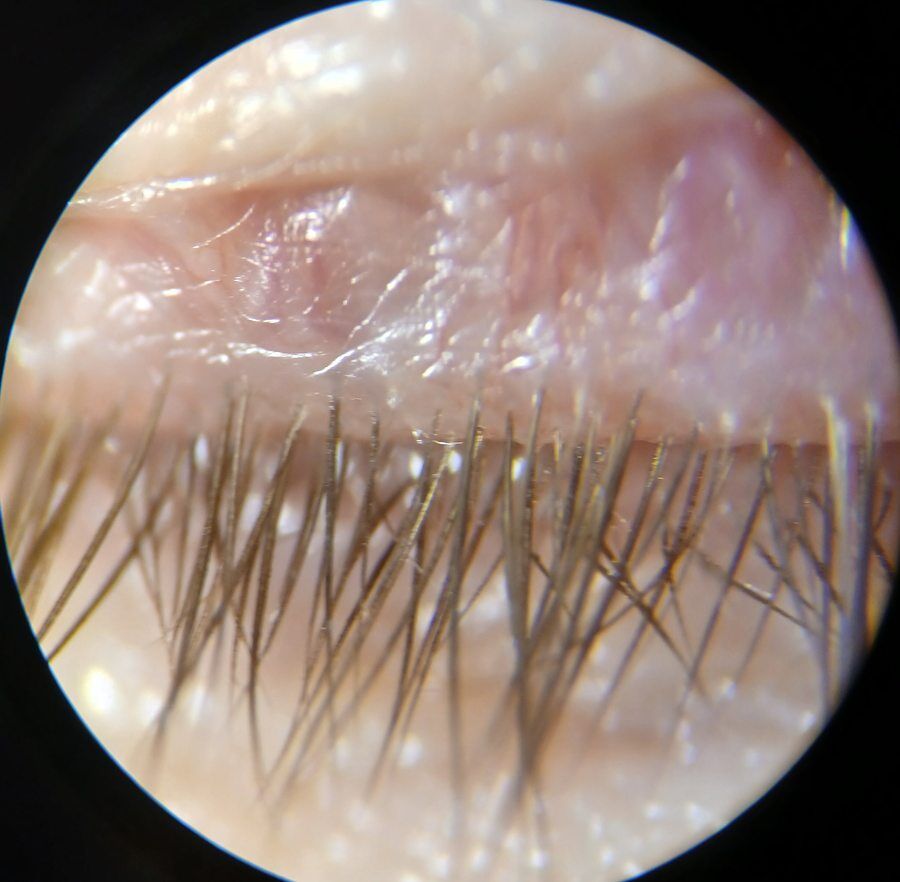
In the full assessment, a quick swab tells us whether there is inflammation keeping your glands blocked. We look along your lashes for the waxy collars that mean mites, for crusting, and for the fine blood vessels that come with rosacea. Each has its own treatment.
- 09
How you blink, then your plan
We watch ten blinks while you talk. If three or more do not close fully, the lower part of your eye dries out all day, and blink exercises go in your plan. Then every result is shown against healthy, we name your type of dry eye, and you take home a written plan with your options.
So you leave knowing exactly what is wrong, how far it has gone, and what will fix it.
Forty-five minutes, and you know more about your eyes than anyone has ever told you. You leave with your results against healthy, your own gland photographs, and a written plan. £50 of the £225 comes off whichever treatment you choose.
“The assessment for dry eyes was very enlightening. In the past two visits I have learned more about my eyes than I did in the previous twenty-five years.”
Everything above is in the £145 assessment except the gland photographs and the inflammation swab, which the £225 full assessment adds. £50 of either is credited to treatment.
Let us show you your eyes
Your glands on the screen, and a plan in your hands.
Almost nobody has been shown their own eyes. The assessment changes that. Your optometrist times how quickly your tears break up, measures how much you make, and shows you the surface of your eye under dye. In the full assessment the oil glands inside your eyelids are photographed and pressed to see which still work. It all goes on the screen, and we explain it in plain words.
That is what the assessment is for: knowing precisely where you are today, so the right treatment can be chosen, and measuring you again at every visit, so that improvement is something you watch happen rather than take on trust. £50 of the assessment comes off any treatment.
Not sure it is dry eye at all? Ask for a Gland Scan at your next eye examination: £15 with any eye examination, and included in our Gold eye examination.

Six questions, one minute
The same symptom score the optometrist uses in the chair. Answer honestly and it tells you whether a Dry Eye Assessment is worth your time.
The first appointment
The first visit, and what you leave with
You choose whether to take each next step. Every one ends with a conversation, not a decision.
The first visit
Nothing decided in the room- 01
The assessment
Thirty minutes with the optometrist. Your tears timed and measured, the surface checked with dye, your lashes examined, and photos or video where they help. If your lids are inflamed, the full assessment adds gland photographs and the inflammation test. £50 of the fee comes off any treatment.
- 02
Treatment within the week
If you want to start, treatment is available within the week, and the same day as the assessment where we can.
- 03
Your options, explained, not pushed
What would help, what it costs, and what happens if you do nothing for now. The plan goes home with you.
What you leave with
A plan, not a guess- 04
What is wrong
Your results against healthy, your score, your type of dry eye, and your gland photographs if you had the full assessment.
- 05
What we suggest
The treatment that fits what was found, and the home routine to start tonight.
- 06
What comes next
When we would see you again, and what better should look like as a number. Treatment, if you choose it, follows the assessment, never a menu.
The report you go home with
The assessment ends with one page, on paper and by email, kept deliberately simple. Three things are on it:
- The finding — your results against healthy, your symptom score, your type of dry eye, and your gland photographs if you had the full assessment
- The recommendation — the treatment that fits the finding, and the home routine to begin that evening
- The next step — when we see you again, and the number that “better” should reach
The prices sit on a separate sheet, so the page is about your eyes and nothing else. Your GP, the hospital or any other optician can read it as it stands.
Treatment
How we treat dry eye
We start by understanding your symptoms and what is behind them. We take the time to understand you. Then we measure what matters, and the assessment gives you a plan with options that fit. These are the three courses, explained, so nothing is recommended that you do not already understand.
Treatment available within the week. Have your assessment and start treatment the same day, where we can.
For blocked oil glands
Three sessions. Each one: a warm mask to soften the oil, every gland cleared by the optometrist, and the lid edges cleaned. A home kit to keep it going, and an end of treatment follow-up where your tests are repeated so you see the change.
- 3 EyeClean sessions: warm mask, every gland cleared, lid edges cleaned
- Home kit
- End of treatment follow-up
Worth £795 if bought separately. £480 as a course.
Add red light therapy to all 3 EyeClean sessions: +£95. Add red and blue light therapy: +£180. For anyone who can’t have IPL.
Most recommended
For most recommended: blocked glands and inflamed lids
Four IPL sessions, two weeks apart. Each one: IPL, then red light, then the glands cleared. One EyeClean session, a home kit, and an end of treatment follow-up. Done within about three months.
- 4 IPL (intense pulsed light) sessions: each one IPL, then red light, then the glands cleared
- 1 EyeClean session
- Home kit
- End of treatment follow-up
Sessions 2 weeks apart, done within about 3 months.
Worth £1,585 if bought separately. £900 as a course.
For inflamed lids and blepharitis
Four IPL sessions with blue and red light, three EyeClean sessions, a home kit and an end of treatment follow-up, all within about three months. For lids where inflammation and blepharitis keep re-blocking the glands.
- 4 IPL sessions with blue and red light
- 3 EyeClean sessions
- Home kit
- End of treatment follow-up
Done within about 3 months.
Worth £2,135 if bought separately. £1,495 as a course.
Single sessions: EyeClean £195 · IPL £295. Red or blue light therapy: £70 on its own, or £35 added to any visit. Warm mask included with every EyeClean and light session.
IPL is available at all five of our practices.
Additional treatments
Small plugs placed in the tear ducts so your own tears stay on the eye for longer. For the water-shortage type. Both eyes, done in the chair.
A soft gel set into the tear duct, lasting around half a year. The gentler cousin of plugs.
When heat and expression cannot open a gland, probing can. Only for the few who need it, and quoted after the assessment.
Made-to-measure scleral lenses that keep a reservoir of fluid over the eye all day, for the most stubborn dry eye. The price follows the assessment.
Staying well
Once the glands are clear, the work is keeping them clear. At the end of treatment follow-up we repeat your tests and agree what keeps them that way: the home routine, and a single session when you need one.
Paying for treatment. Every price is shown before you decide anything. Pay in full, or half today and half at your next visit, and £50 of your assessment comes off whichever you choose. Every price on one page →
 BeforeAfter
If you wait
Why we would rather look now than later
Blocked glands can be cleared
Oil that has set inside a gland can be softened and expressed, and the gland goes back to work. That is what EyeClean does, and it is why people who come early usually need three visits and a routine, not more.
Left alone, they shorten
Months and years blocked and a gland starts to shrink from the back. In gland photographs, glands that once ran the full depth of the lid stop half way.
Lost glands stay lost
A shortened gland can disappear altogether, and nobody has found a way to bring one back. What remains can be looked after and symptoms still helped, but the aim is to reach you before then.
Not a reason to panic. It is the reason we look properly, and the reason we tell you what we see on the day.
Not sure it is dry eye?
People rarely arrive saying “dry eye”. They arrive saying one of these.
Each has its own page: what it usually is, and what to do. Or skip the reading and book a Dry Eye Assessment.
Same words, three different plans
Three people can walk in saying “dry eyes” and walk out with three different plans, because the plan comes from what the assessment found. The quotes below are our patients’ own words, already published on this site.
“I could actually see the blocked oil coming out during the treatment. It was oddly satisfying, and the relief was immediate.”
“I’d been using drops eight to ten times a day for years. After the EyeClean Programme, I barely need them anymore. I only wish I had found this sooner.”
“I was told by two other opticians that it was just dry eye and there was nothing to be done. The imaging showed me exactly what was wrong. Seeing my blocked glands on the screen made it all make sense.”
Now you can see why nothing else worked
Once you understand what’s actually blocked, the pattern becomes obvious:
| What you’ve tried | What it does | Why it stopped working |
|---|---|---|
| Eye drops | Replace tears for a few minutes | Nothing for the blocked glands; the oil layer is still missing, so the drops evaporate too |
| Warm flannel at home | Softens the oil briefly | Can’t hold 40–42°C for long enough, and nothing expresses the gland afterwards, so the oil re-hardens |
| Lid wipes | Clean the lid surface | Don’t reach the gland openings or the debris at the lash base |
| IPL on its own | Calms inflammation | Doesn’t clear blocked glands. We use IPL and red light with gland treatment, not instead of it — that’s EyeRelief and EyeRelief Max |
| Our approach | The treatment you actually need | Nothing — chosen from your assessment, not guessed |
Two conditions. One integrated approach.
Because MGD and blepharitis so frequently occur together, we rarely treat one without assessing for the other. Our specialists are trained to diagnose both, understand how they interact in your specific case, and deliver a treatment plan that addresses everything — not just the loudest symptom.
The BlephEx treatment that forms the first stage of every EyeClean session was originally developed as a blepharitis treatment. The manual gland expression that follows addresses the MGD. In most patients, both are needed. In most patients, both are present.
If you’re not sure which condition is causing your symptoms, that’s exactly what your assessment is for. Understand blepharitis and how we treat it →
Why Abra & Co
We didn’t start offering dry eye treatment because it became fashionable. We started because our patients kept coming back with the same unresolved symptoms, and we refused to accept that drops and warm flannels were the best we could offer them.
Our co-founder Sohail Khan began developing our approach in 2017, learning from ophthalmologists and attending specialist conferences across Europe — Silmo, Mido, and ophthalmology forums — driven by a straightforward belief: that our patients deserved a real solution, not a temporary one. He has personally treated over 500 dry eye patients.
Co-founder and Clinical Director Abra Arshad then built the diagnostic protocols, introduced standardised OSDI assessments and symptom scoring across all five practices, sourced the clinical equipment, and personally trained and mentored every optometrist who delivers our dry eye treatments today.
Seven trained optometrists. Five practices. Over 600 patients treated through the EyeClean Programme. Early results: 9 in 10 of our EyeClean patients told us their symptoms improved.
We’re independent. We’re family-run. And we take this personally — because our patients are our community, and their comfort matters to us long after they leave the chair.
Reviews
What our patients say
4.9★★★★★
G 600+ Google reviews across five practices
“Brilliant service very friendly staff and a no rush service Really informative and helpful when reviewing and selecting a new pair of glasses would highly recommend”Google review · Middleton · July 2026
“Many thanks to Abra & Co. I greatly appreciate the time that they spent helping me select the perfect glasses. The staff are friendly, informative and knowledgeable. I’ll be returning for years to come.”Google review · Middleton · April 2026
“Absolutely fabulous, professional and friendly always looking after me would recommend them”Google review · Middleton · March 2026
Advanced diagnostic imaging at every practice
We use specialist diagnostic equipment at every one of our five practices — because understanding your dry eye properly requires seeing it clearly.
Cheadle — HD Firefly Digital Slit Lamp. Ophthalmology-grade microscope with high-definition digital recording. We show you your meibomian glands on a large screen, explaining exactly where the blockages are.
Middleton — Occify diagnostic imaging. Advanced anterior segment imaging for detailed assessment of gland structure and tear film quality. IPL and light therapy are delivered here.
Heald Green, Winsford & Heckmondwike — Specialist slit lamp assessment with meibomian gland evaluation and tear film quality mapping at every visit. IPL and light therapy here too.
Every assessment includes standardised symptom scoring, lifestyle and environmental review, tear film measurements, surface staining, an eyelash check, each result shown against healthy, and a personalised written treatment plan in plain English. The full assessment adds gland photographs and the inflammation test.
 Slit-lamp gland imaging at every practice
Meibomian gland evaluation and tear-film quality mapping at every visit, at all five practices. Middleton also runs the Occify anterior-segment imager.
 Eye-light — IPL and red light
The handpiece delivers the IPL flashes across the cheek and lower lid; the mask delivers the red light to the gland tissue. A quarter of an hour, no gel, and nothing makes contact with the eye.
HD Firefly digital slit lampOphthalmology-grade microscope with a built-in HD camera and infrared meibography — the sharpest gland picture in the group. You see your glands on a large screen and the recording is kept for the next visit.
These are the manufacturers’ photographs; ours are the same devices without the studio lighting.
Book
Book at your nearest practice
Five practices across Greater Manchester, Cheshire and West Yorkshire. Pick the nearest and the number and the booking link change to match.
Treatment available within the week. Have your assessment and start treatment the same day, where we can. No referral needed. Gland Scan: £15 with any eye examination (included in our Gold eye examination).
Frequently asked questions
My eyes are itchy and gritty. Is that dry eye?
Usually. Itchy, gritty eyes that worsen through the day are the most common sign of blocked oil glands in the lids, and the Dry Eye Assessment shows whether yours are blocked. Gritty, burning eyes →
Why do my eyes water if they are dry?
A dry surface makes the eye pour out thin, watery tears in self-defence. They run off and do nothing for the dryness. Eyes that stream in the wind or the car for no reason are one of the clearest signs of blocked glands. Why dry eyes water →
My eyes changed with the menopause. Is that connected?
Very often. Lower oestrogen thickens the oil in the glands and cuts tear production, so dry eye tends to begin or worsen around then. It responds to treatment, and it brings a great many women to us. Dry eyes and the menopause →
I use a CPAP machine and wake with sore eyes. Why?
Air escaping upward from the mask dries the eye surface through the night. It is common, and it can be sorted, partly by the mask fit and partly by protecting the eye. CPAP and dry eyes →
Can dry eye make my vision blurry?
Yes, and it is one of the most missed symptoms. An unstable tear film scatters light, so the picture blurs and then clears on a blink. Vision that comes and goes after a spell on the screen is very often dry eye rather than a change in prescription.
Which assessment should I book?
Most people start with the Dry Eye Assessment, £145: thirty minutes, your tears and the surface of the eye measured, your lashes checked, and a written plan. If your lids are inflamed, or the optometrist has recommended it, the Full Dry Eye Assessment, £225, adds gland photographs and the inflammation test. £50 of either is credited to treatment.
Do I need a GP referral?
No. Book online or ring whichever practice is nearest.
How do I know which type of dry eye I have?
You do not need to before you come. Working that out is what the assessment is for, with the gland photographs, the tear measurements and the symptom score.
Show all 14 questions
Is the treatment available at every practice?
Yes. All five practices run the full EyeClean programme with the same equipment and the same protocol. IPL and light therapy are available at all five practices too.
How quickly will I notice a difference?
Many people feel a change after the first EyeClean visit. The course runs three sessions and the improvement builds through it, with an end of treatment follow-up to measure the change; after that most people keep well with a single session now and then.
What if I’m not sure it’s dry eye at all?
Take the 60-second check, or ask for a Gland Scan at your next eye examination: £15 with any eye examination, and included in our Gold eye examination. We see plenty of people who were told it was allergy, their prescription, or simply age, and the glands turned out to be the reason.
How soon can I start treatment?
Treatment is available within the week. Have your assessment and start treatment the same day, where we can.
How do I pay for treatment?
Pay in full, or half today and half at your next visit. Every price is shown before you decide, and £50 of your assessment comes off whichever treatment you choose.
Do you offer IPL?
Yes, at all five practices, within EyeRelief (£900) and EyeRelief Max (£1,495), always alongside gland treatment, where inflammation is driving the dry eye. A single IPL session is £295. How the light works →