
Discover RGP lenses.Small, firm, breathable lenses, made to measure. Often sharper than soft, and they can help you read again.
A small, firm lens that floats on your tears.
RGP stands for rigid gas permeable. In plain words: a small, firm contact lens made from a material that lets oxygen pass through to your eye. You may have heard them called hard lenses. Today’s are a breathable version.
Most people know soft lenses: thin, floppy, and wide enough to cover the whole coloured part of the eye. An RGP lens is smaller and holds its shape. It rests on a thin layer of your own tears and moves a little each time you blink.
Why choose one? Because it keeps its shape, it often gives sharper sight if you have astigmatism or a strong prescription. With good care a pair often lasts a year or more, so you throw far fewer lenses away.
You will feel it at first. Most people settle within a week or two.
And it isn’t taken from a box. We map the front of your eye, and your lenses are made to measure from that map.
So, is an RGP lens for you? See if any of this sounds familiar.
It isn’t for everyone, so let’s see if you’re one of the people it helps most.
With astigmatism or a strong prescription, a soft lens can bend with your eye and lose sharpness. An RGP lens holds its shape, so the vision through it is often noticeably crisper.
You don’t have to give up the lenses you know. RGP lenses come in varifocal designs too, so you can keep the sharpness you’re used to and read again.
That’s often about soft lenses. Made-to-measure RGP lenses can cover prescriptions soft lenses can’t. Come and let us look before you give up.
They take a little getting used to, usually a week or two. They let plenty of oxygen through to your eye, and we build up your wearing time gently.
A soft lens copies your eye, bumps and all. An RGP lens doesn’t.
Here’s why a firm lens sees sharper. A soft lens drapes over your eye and follows every curve, bumps and all.
An RGP lens keeps its own smooth shape. Your tears fill the gap underneath and become a second lens. Together they give your eye a new, smooth front. That’s why the vision is often crisper.

Now add reading. Far, middle and near in one lens.
An RGP lens can also be a varifocal: one lens with strengths for far, middle and near. Soft varifocal lenses come in set sizes and strengths. An RGP varifocal lens is designed around you: the shape of the front of your eye, the size of your pupil, where your lids sit, and how you use your eyes every day.
That’s why the fitting takes a little longer, and why we refine the lens over a few visits until the vision and comfort are right.
See the science, step by step (9 pictures)
Why it works: your own tears become a second lens.
Here’s how an RGP varifocal lens is made for you, one step at a time.
- Step 1 of 9
First, we map the shape of your eye.
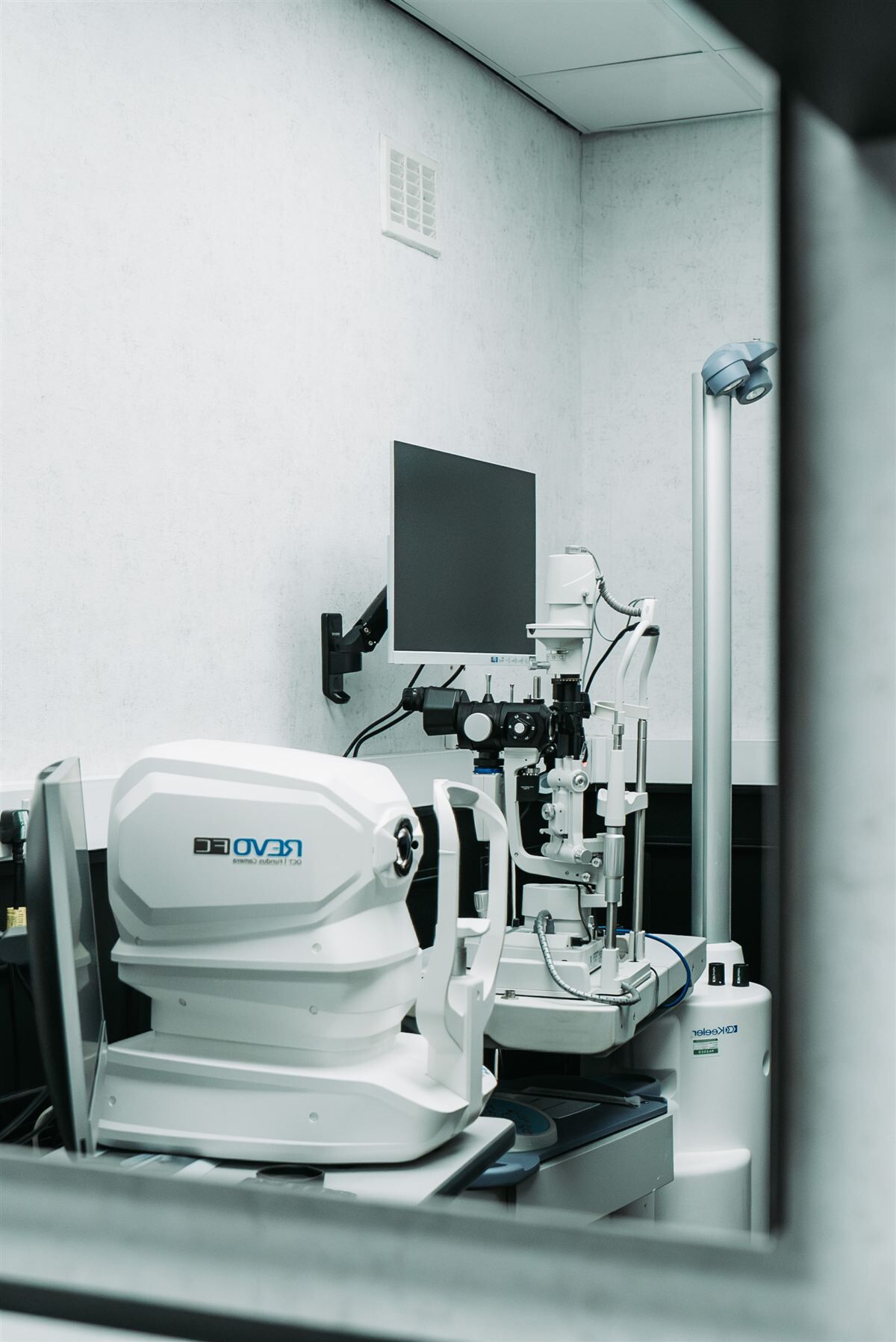
We use an eye-mapping scanner (a corneal topographer called the OS1000). You rest your chin, look into the lit rings, and in a few seconds it measures the front of your eye at thousands of points.
Nothing touches your eye.

- Step 2 of 9
No two eyes are quite the same shape.
The scan gives us a colour map of your eye. Warm colours show where it is higher, or steeper. Cool colours show where it is lower, or flatter.
Most eyes are a little uneven, and astigmatism makes them more so. We can show you your own map on screen straight away.
- Step 3 of 9
Then we make your lens to match. Like a tailored suit.
We design your lens from that map, instead of guessing from a box. It is made for your eye alone, like a suit cut to your measurements rather than picked off the rail.
- Step 4 of 9
Underneath, your own tears become a second lens.
Under an RGP lens sits a very thin layer of your own tears. Its top takes the smooth shape of the lens. Its underside fills every dip and bump on the front of your eye.
So it works as a lens in its own right. We call it the tear lens.
- Step 5 of 9
Together, they give your eye a new, smooth front.
Your tears and the front of your eye bend light almost exactly the same way. So once the tears fill the bumps, the unevenness all but disappears.
The RGP lens and the tear lens together make an artificial front surface for your eye, smooth and regular where your own was uneven. Light enters through it and focuses sharply. That’s why RGP lenses often give clearer vision than a soft lens, especially with astigmatism or an irregular eye.
And because we design the back of your lens from your eye map, we control the tear lens too: a little thicker or thinner in places to fine-tune your focus, centre the lens over your pupil, and let fresh tears flow under it with every blink. That keeps it comfortable and your eye healthy.
- Step 6 of 9
Rings for far, middle and near, placed over your pupil.
Most RGP varifocals have rings or a smooth blend of strengths: one for distance, one for the middle (a laptop or dashboard) and one for close up. They all sit in front of your pupil at once, and your brain learns to pick out the sharp picture and ignore the rest.
The rings only work if they sit exactly over your pupil. So we measure your pupil in bright and dim light, and where your lids sit, and size and place the zones around them. That’s how an RGP lens can be both sharper and more comfortable than a lens from a box.
- Step 7 of 9
At night, your pupil opens wider.
In dim light your pupil gets bigger and looks through more rings at once. That’s why some people see halos around lights at night, especially when driving.
We measure your pupil in dim light too, and design around it. More on this in the honest bit below.
- Step 8 of 9
For some eyes, a lens that moves as you read.
Some eyes suit a different design, like a bifocal: distance at the top, reading at the bottom. When you look down, your lower lid holds the lens up, so your pupil moves into the reading part.
It can give very crisp near vision, and suits some eyes and lids better than others. We’ll tell you which design suits yours.
- Step 9 of 9
It takes a week or two to feel natural.
RGP lenses are firm, so you will feel them at first. Most people notice them less each day and, after a week or two, barely notice them.
Some take longer. We see you along the way and adjust the lens if we need to.
The aim is clear distance, comfortable middle distance and easy reading in one lens. For most people we get very close. For some, we get as close as their eyes allow, and we tell you honestly where that is.
Who they suit, and when something else is better.
- Over-forties with astigmatism, where soft varifocal lenses aren’t sharp enough
- People with strong prescriptions
- People who already wear RGP lenses and are starting to struggle with reading
- People who want the crispest vision their eyes allow from a contact lens
- RGP lenses take a week or two to get used to, so they suit people happy to give them that time
- If you only want lenses now and then, soft daily lenses are usually easier
- If a small RGP lens doesn’t feel comfortable, a larger lens that rests on the white of the eye (a mini scleral) often does
We often don’t know what will suit you until we’ve tested your eyes, understood how you spend your day, and let you try. So we never guess.
RGP, soft or monovision? Now you can see which fits you.
The honest bit: where varifocal lenses can struggle, and what we do about it.
Every varifocal lens, RGP or soft, is a clever compromise. It shares the light coming into your eye between distances. Here’s what that can mean in real life.
In dim light, at night or in a dark restaurant, your pupils widen. More of the lens’s outer zones come into play, so some people see halos or glare around headlights and street lights, and night driving can feel less crisp. In bright sunshine your pupils shrink, which can change the balance between near and far.
Because the lens shares the light between distances, contrast can be a touch lower than with a lens for one distance only. Most people don’t notice it day to day. People who do very fine detailed work sometimes do.
Unlike a soft lens, you can feel an RGP lens for the first few days, mostly as your eyelids brush its edge. We build up your wearing time over a week or two, and most people stop noticing them. If you don’t settle, a larger lens that rests on the white of the eye is often much more comfortable.
The first week or two can feel slightly strange while your brain learns to pick the sharp image from the zones. Most people settle in, and it’s why we follow you up.
An RGP lens floats on your tears. If your tears are thin or dry, vision can flicker between blinks and feel less sharp by the end of the day. That’s why we check your tears and lids first, and treat them if they need it.
From your late fifties the reading part needs to be stronger, and it gets harder to make everything perfect at once. We may fine-tune the design, try a slightly different strength in each eye, or suggest light reading glasses for very small print.
The lens has to move up the right amount when you look down. If your lower lid sits low or is loose, it may not, and a blended design may suit you better.
How we get you the best vision your eyes allow
- We measure your pupil in bright and dim light, so the zones are the right size for how you live.
- We centre the design on your pupil and refine it over follow-up visits.
- We can set up each eye slightly differently, for example favouring distance in one eye, to sharpen night driving or reading.
- We tell you honestly if a back-up pair of glasses for night driving or small print would help.

£200 to get it right, however many visits it takes.
- We talk firstHow you use your eyes: screens, reading, driving, hobbies. What you’ve tried before, and what didn’t work.
- We map your eyeWe measure the shape of the front of your eye in detail and check your tears and lids, because they decide how an RGP lens will sit and feel.
- We design and try your lensesTrial lenses chosen from the map of your eye. We check how they sit, how they move when you blink, and how well you see near and far.
- Teaching, at your pacePutting RGP lenses in and taking them out is a little different from soft lenses. Nobody leaves until they’re confident.
- Follow-ups until it’s rightWe see you again to refine the fit and the vision. Nothing is ordered until you’ve agreed the total.
Specialist fitting £200, with teaching and follow-up visits
Your lenses are quoted in writing before anything is ordered
Aftercare check £70 a year
Still wondering? Here are the answers.
How long does it take to get used to RGP lenses?
Usually a week or two. You build up wearing time gradually, and most people find they stop noticing them.
Will I need reading glasses as well?
For most everyday reading, no. For very small print or long close work, some people keep a light pair handy. We’ll tell you honestly what to expect.
How long do RGP lenses last?
Often a year or more with good care, much longer than soft lenses. We’ll confirm how often yours need replacing when we quote for them.
Can I have them if I have astigmatism?
Yes. RGP lenses are often a very good choice for astigmatism, because they hold their shape on the eye.
How much does it cost?
The specialist fitting is £200, including the teaching and follow-up visits. RGP lenses are made to measure, so we quote for them in writing, and nothing is ordered until you’ve agreed the total.
I already wear RGP lenses from somewhere else. Can you help?
Yes. Bring your lenses and any old prescriptions, and we’ll look at whether a varifocal design would work for you. An aftercare check is £70.
Five practices. The same care at every one.
We fit RGP varifocal lenses at all five practices: Cheadle and Heald Green for Stockport and south Manchester, Middleton for north Manchester, Rochdale and Oldham, Winsford for mid-Cheshire, and Heckmondwike for Kirklees, Batley and Dewsbury. Same prices at each. Book online and we’ll ring you to confirm, or call your nearest practice.
Ready to see how sharp your eyes can be? Book your RGP fitting.
Want to understand more before you come in?