
Discover the Clarity of Varifocal Contact Lenses at Abra and Co. Opticians
Introduction Varifocal contact lenses are a modern solution for individuals experiencing presbyopia, a common age-related vision condition. These lenses offer


Every summer, people reach for sunglasses to cut the glare. Fewer people think about what is actually happening to their eyes in June, July, and August — and why the damage, when it comes, does so silently over decades rather than in a single afternoon.
UV radiation is the part of the sun’s energy spectrum you cannot see or feel. It does not cause pain in the moment. There is no immediate signal to tell you that your cornea is absorbing it, or that your lens is accumulating changes that will eventually affect your vision. That invisibility is precisely what makes it one of the most underestimated risks to long-term eye health in the UK.
At Abra & Co, our optometrists see the cumulative effects of UV exposure regularly — in patients who developed cataracts earlier than expected, in corneal tissue that has changed over years of outdoor exposure, and in retinal health assessments that show why earlier habits matter. This guide sets out what is actually happening, what protection genuinely works, and what to do if you are unsure whether your eyes are properly covered this summer.
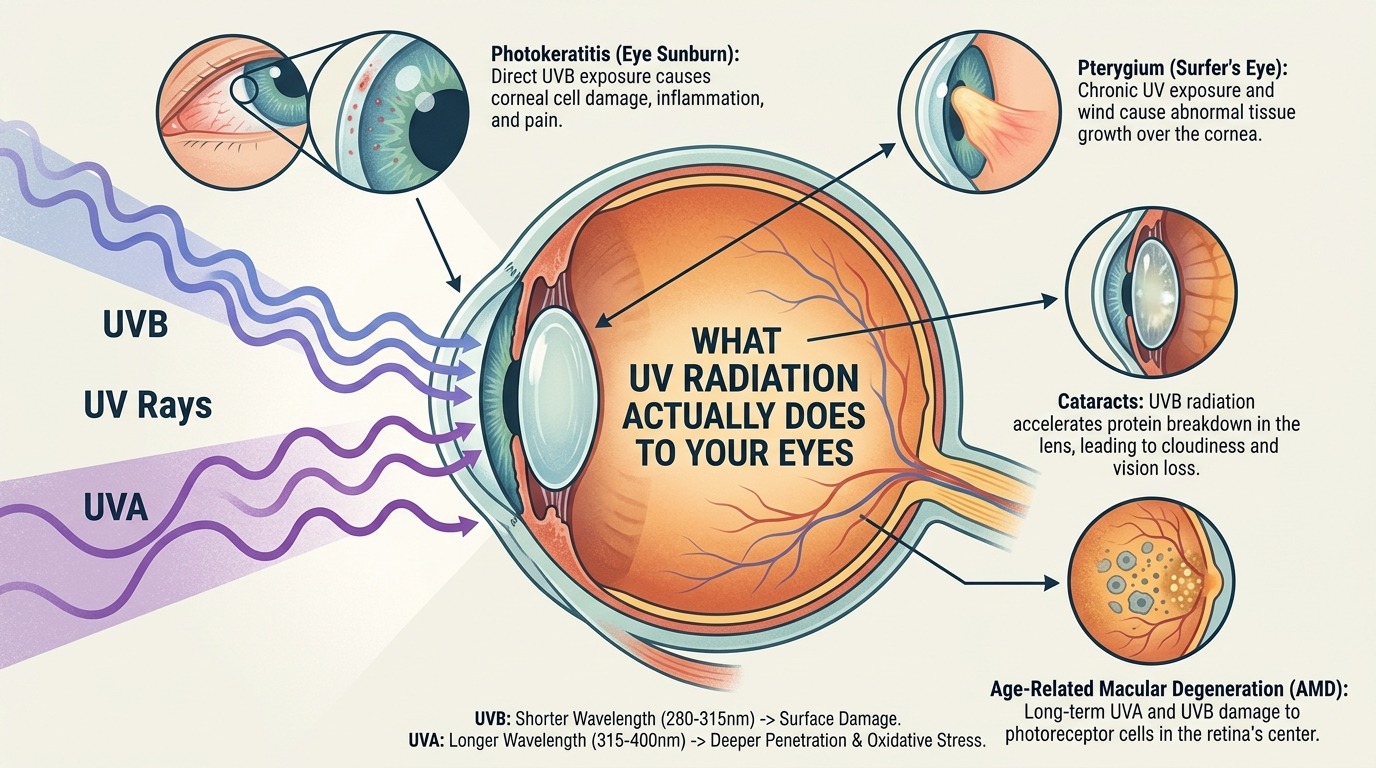
Ultraviolet radiation reaches the eye in two forms that matter clinically: UV-B and UV-A. UV-B, which has higher energy, is largely absorbed by the cornea and the front surface of the lens. This is the type associated with photokeratitis — a painful but temporary sunburn of the cornea that occurs after intense acute exposure, typically from reflected light off water, sand, or snow.
UV-A penetrates more deeply. It passes through the cornea and reaches the crystalline lens, where it contributes to protein changes associated with cataract formation. Over many years, UV-A also reaches the macula — the central region of the retina responsible for detailed vision — and is one of the environmental factors linked to age-related macular degeneration.
What both types share is a cumulative mechanism. Each exposure adds to the total, and the effects become clinically visible only after years or decades. This is why protection at every life stage matters — and why children’s exposure is particularly significant.
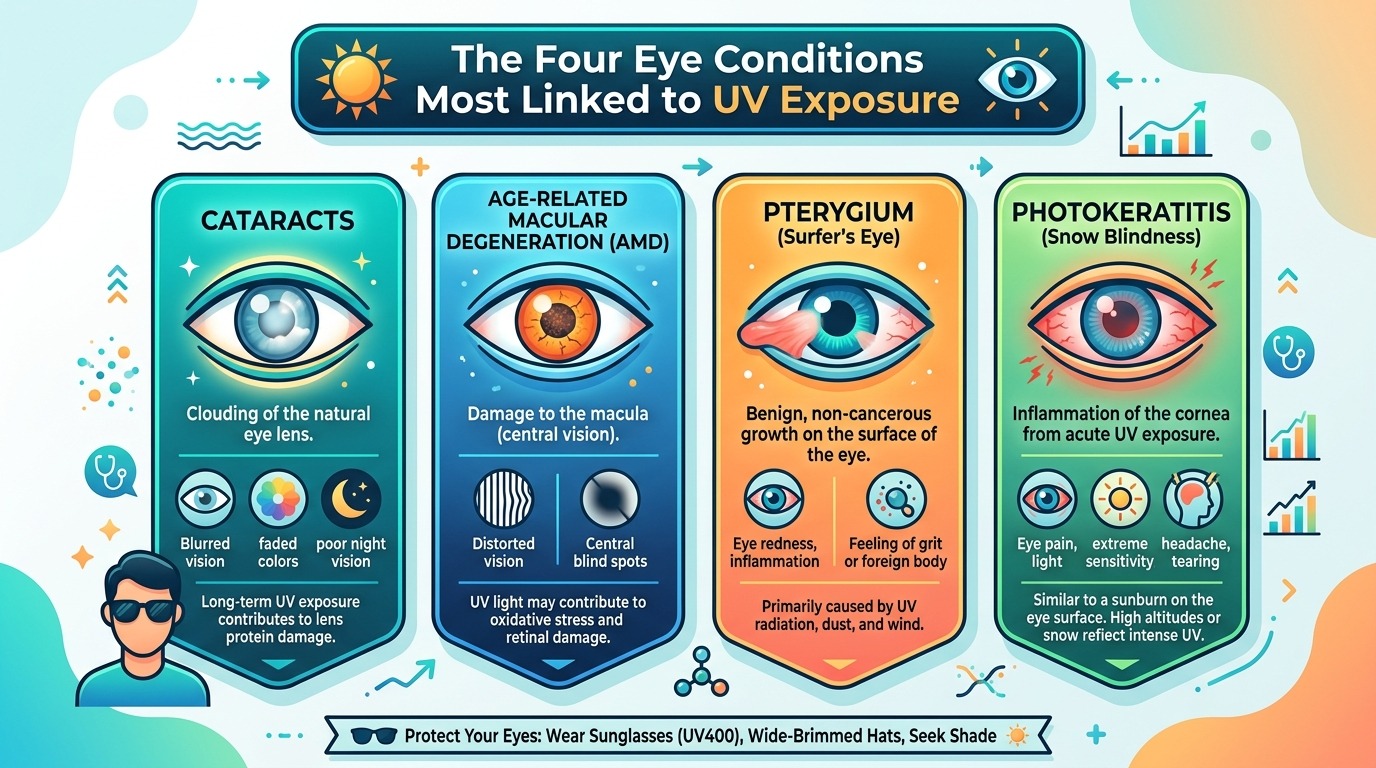
UV-B accelerates clouding of the crystalline lens. The WHO estimates that up to 20% of cataracts may be attributable to UV exposure — making it one of the most significant modifiable risk factors for this condition.
AMD is the leading cause of irreversible sight loss in the UK. UV-A exposure and blue light are both implicated in oxidative stress on macular tissue over time. Early detection through regular eye examinations significantly improves outcomes.
A growth of conjunctival tissue across the cornea, strongly associated with outdoor UV exposure. It affects vision and comfort, and typically requires surgical removal once established. Wraparound sunglasses reduce the peripheral UV exposure most associated with this condition.
The eye’s equivalent of sunburn — painful, temporary, and a clear signal of acute overexposure. Common on sunny holidays near reflective surfaces such as water, sand, or snow without adequate eye protection.
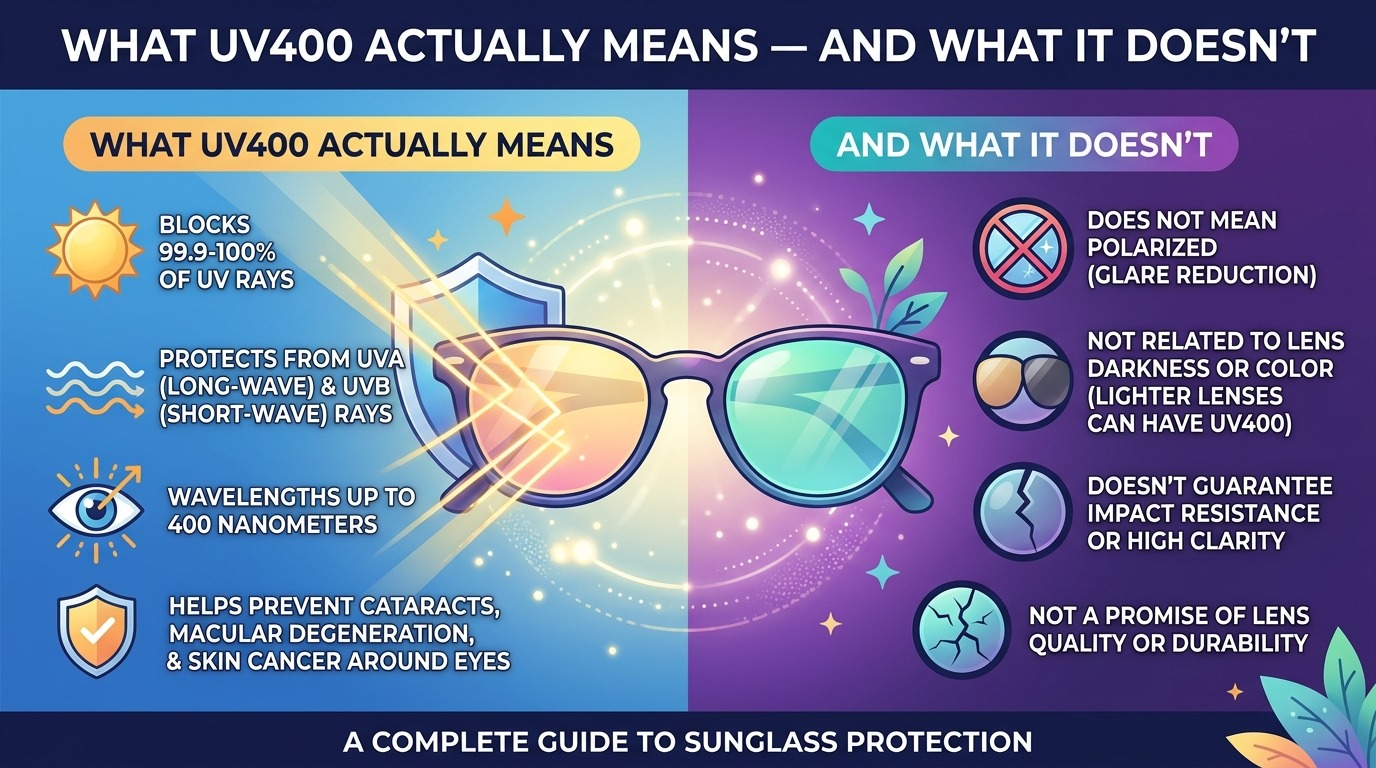
The standard to look for on sunglasses in the UK is UV400 protection — meaning the lenses block wavelengths up to 400 nanometres, covering both UV-A and UV-B. CE-marked sunglasses meeting the EN ISO 12312-1 standard should meet this requirement. This is the baseline.
What UV400 does not guarantee is physical coverage. Lens size and frame fit matter significantly. A close-fitting or wraparound frame reduces UV entering around the sides and above the lens — where peripheral exposure contributes to conjunctival and lid margin damage over time.
There is also a common and important misconception about lens tint. Tint category (0–4) refers to how much visible light the lens transmits — it is about glare and visual comfort, not UV protection. A very dark lens without UV400 certification is worse than wearing nothing: it causes the pupil to dilate, allowing more UV to reach deeper structures while giving a false sense of protection. Always check for the UV400 marking — tint level tells you very little about UV blocking.
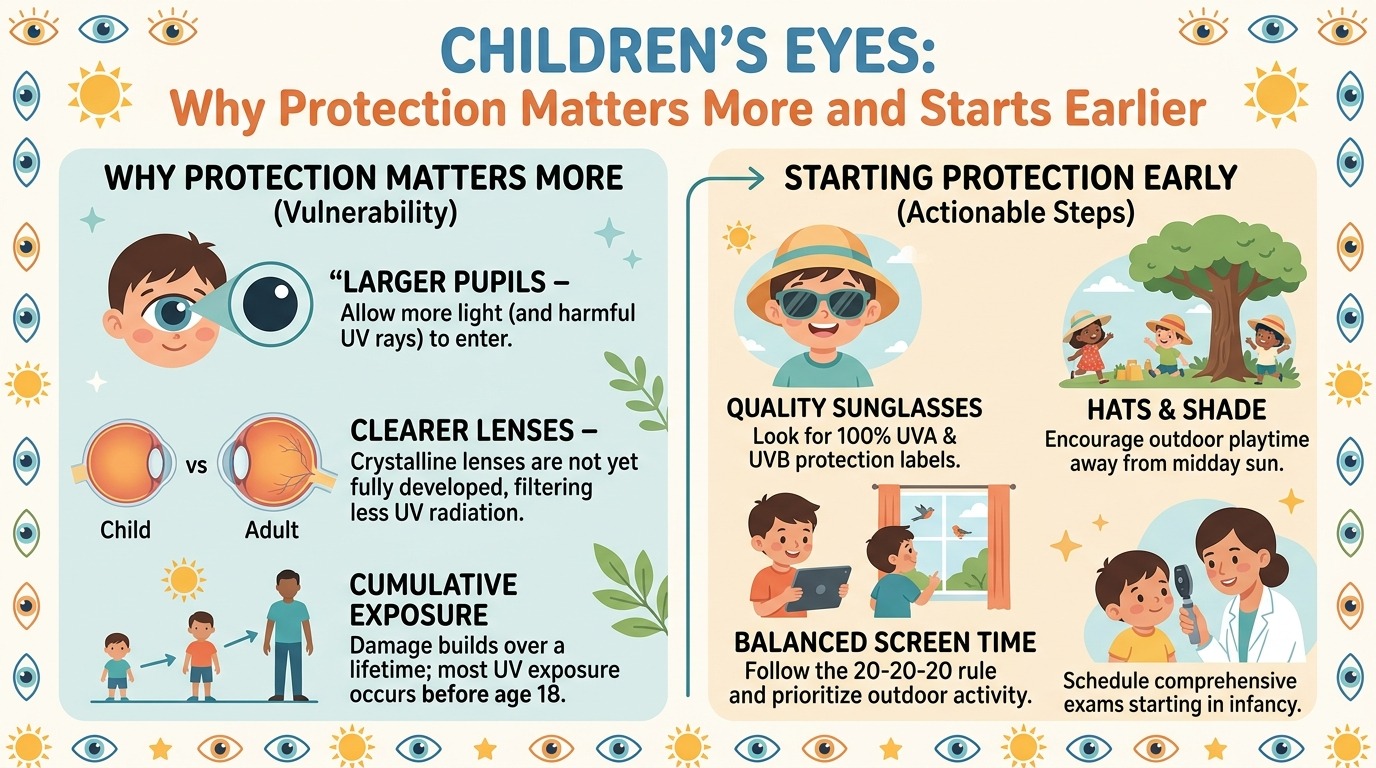
Some research suggests that half of a person’s lifetime UV exposure can accumulate before the age of 18. Children’s crystalline lenses are clearer than adult lenses — they transmit significantly more UV to the retina, and their pupils tend to be larger. Combined with more time spent outdoors during school holidays and sport, the case for providing children with quality UV400 sunglasses from an early age is strong.
Wide-brimmed hats provide additional protection that sunglasses cannot cover — specifically the superior visual field, which is often the most UV-intense direction when the sun is high.
For people who wear glasses, UV protection often defaults to nothing practical — switching between regular glasses and non-prescription sunglasses is inconvenient. Prescription sunglasses or photochromic lenses that adjust outdoors solve this directly. They also ensure the optical correction is maintained, rather than compromising vision in favour of protection.
Some contact lenses now carry a UV-blocking coating, but they cover only the cornea — not the conjunctiva, eyelid margins, or the surrounding structures. UV-blocking contacts can be part of a layered approach, but they are not a substitute for sunglasses.
There is also a less commonly known connection between UV exposure and dry eye. Prolonged exposure to summer conditions — UV, wind, and reduced blinking during outdoor activity — can aggravate meibomian gland dysfunction (MGD), the most common underlying cause of evaporative dry eye. If your eyes feel dry, gritty, or irritated in summer despite using drops, the gland function is worth assessing properly rather than simply managing the symptom.
Do I need sunglasses on cloudy days in the UK?
Yes. Up to 80% of UV radiation passes through cloud cover. Overcast conditions give a false sense of safety because glare is reduced — but UV levels remain significant, particularly between 10am and 4pm throughout summer.
Are cheap sunglasses from market stalls or holiday shops safe?
Not reliably. Without verified UV400 certification and CE marking, there is no guarantee of protection. A dark tint without UV blocking is actively harmful — it dilates the pupil while providing no UV filtration. Buying from a registered optician provides certainty.
My contact lenses have UV protection — do I still need sunglasses?
Yes. UV-blocking contact lenses protect only the area of the cornea they cover. The conjunctiva, eyelid margins, and surrounding tissue remain exposed. Sunglasses provide broader coverage that contacts cannot replicate.
Can UV exposure cause or worsen dry eyes?
Indirectly, yes. Wind, UV, and reduced blink rate in outdoor conditions can aggravate meibomian gland dysfunction — the most common cause of evaporative dry eye. If summer consistently worsens your symptoms, the underlying gland function is worth assessing clinically rather than simply managing with lubricating drops.
How often should I have an eye examination if I spend a lot of time outdoors?
Annual examinations are appropriate for most adults. Regular examinations allow early detection of UV-related changes — including early lens clouding, macular changes, and conjunctival tissue changes — before they affect vision significantly.
Are photochromic lenses as protective as sunglasses?
For UV protection, yes — photochromic lenses typically provide full UV400 protection regardless of how dark they have turned. They do not get as dark as dedicated sunglasses in very bright conditions. For driving, most photochromic lenses do not darken significantly behind a windscreen, which already filters UV — polarised prescription sunglasses may be a better choice for regular drivers.
A summer eye examination with our optometrists includes a full assessment of your vision and eye health — and where relevant, a review of your UV protection and dry eye status. We offer prescription sunglasses, photochromic lens fitting, and dry eye consultations across all our practices.
If you have not had an eye examination in the past two years, or you have noticed changes in your vision or comfort this summer, this is the right time to book.
Book online at abra.mysight.uk or visit abra-opticians.co.uk
Introduction Varifocal contact lenses are a modern solution for individuals experiencing presbyopia, a common age-related vision condition. These lenses offer
I know the M62 like the back of my hand. I spend a lot of time on that road, traveling

If you’re reading this, you’re probably trying to work out whether you or a family member qualifies for a home